Handrail
Built: July 27, 2026
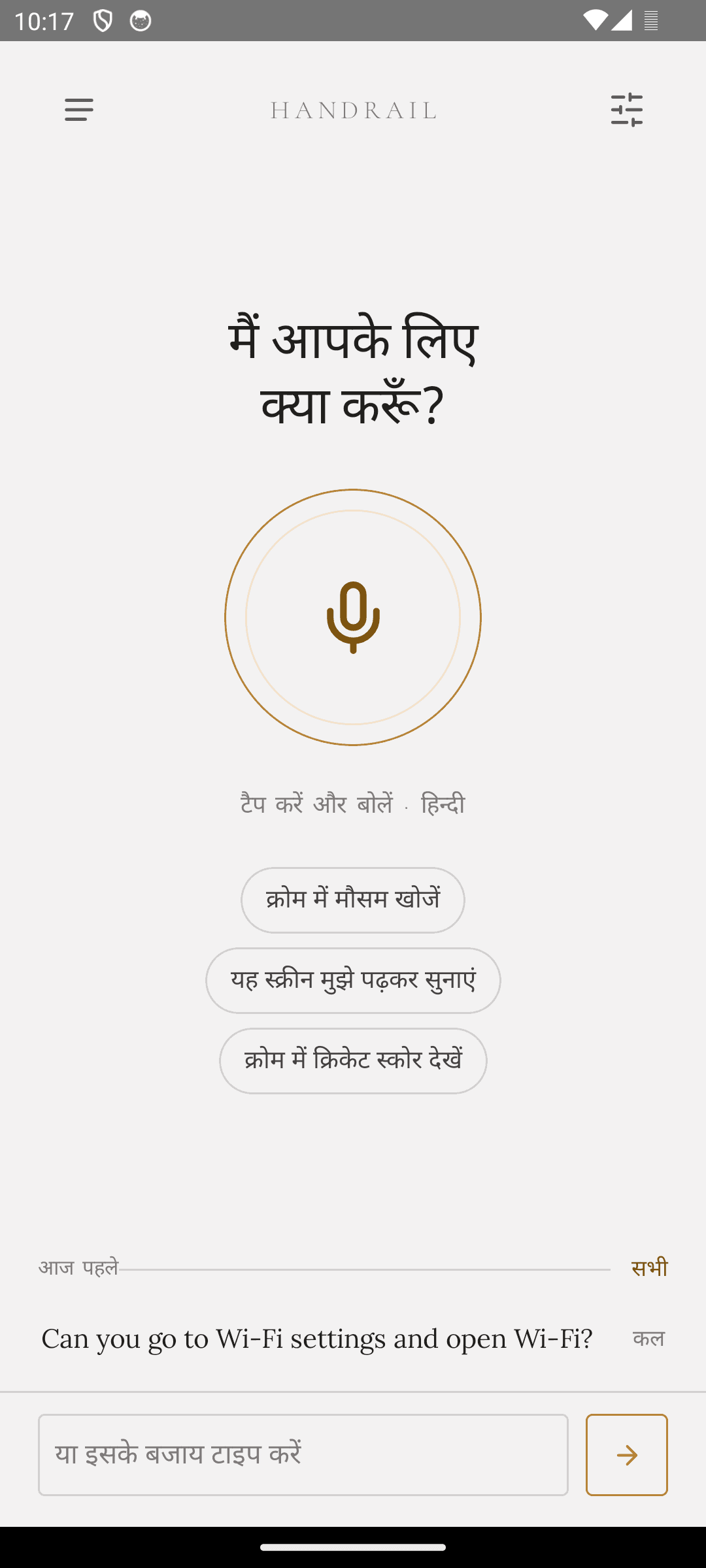
Built for the Sarvam hackathon, Handrail is a native Android accessibility agent aimed at anyone who finds a phone screen hard to parse — narrating what's on screen and, when asked, driving multi-step tasks through it — entirely in Indian languages, with no vision model in the loop.
There are two modes over one shared perception layer.
Narration mode
Long-press home to invoke Handrail as the system assistant (a real ASSIST intent handler, not a floating-bubble hack). It grabs the current screen through Android's AccessibilityService node tree, sends a filtered summary to an LLM, and speaks the result back in the user's language via Sarvam Bulbul TTS. No screenshots, no OCR, no screen-capture APIs — Sarvam has no screen-grounding vision model, so grounding comes entirely from the accessibility tree.
Takeover mode
Speak a task (captured via Sarvam Saaras STT) and Handrail runs an agent loop: perceive the screen → an LLM picks the next tool call (tap, set_text, scroll, back, home, done, ask_user, blocked) → execute it → narrate the step aloud → re-perceive → repeat, capped at a 12-step budget.
The hard stop is the actual feature. Before executing any tap, the target node's text is checked against a keyword list — pay, send, confirm, order, submit, transfer, and Hindi/Kannada equivalents — in code, not just prompt instructions. On a match, Handrail narrates what the button is about to do and hands the final tap back to the user instead of completing it.
Perception, kept small
Raw accessibility trees blow past any reasonable context window, so every pass:
- keeps only nodes that are clickable, editable, scrollable, checkable, or carry text/content-description
- assigns each a short ref (
e1,e2, …) and serializes it one line per node, e.g.e4 Button "Pay now" clickable bounds=[540,1820] - caps output at ~150 nodes, preferring on-screen actionable elements
- re-resolves refs from the latest pass on every step — stale
AccessibilityNodeInfoafter a screen change is a real crash source, not a hypothetical one
Text entry gets the same honesty treatment: ACTION_SET_TEXT silently fails on WebViews and some custom fields, so every set_text re-reads the node afterward and falls back to clipboard + paste if it didn't take — and reports failure to the agent loop rather than pretending it worked.
The perception layer is adapted from MobileClaw (MIT).
Stack
- Kotlin, native Android,
minSdk 26— Jetpack Compose for UI - AccessibilityService + AccessibilityNodeInfo tree for perception — no vision, no screenshots
- Sarvam Saaras (STT) and Sarvam Bulbul (TTS)
- Reasoning/tool-calls behind a single OpenAI-compatible chat-completions client (plain OkHttp + kotlinx.serialization), switchable between an OpenRouter dev config and the shipping Sarvam endpoint behind one flag
- kotlinx-coroutines for overlapping TTS narration with the next perception pass